Condensed mathematics
Reading group @ Dpto. de Álgebra of Universidad de Sevilla
Spring 2026
Condensed mathematics
Reading group @ Dpto. de Álgebra of Universidad de Sevilla
Spring 2026
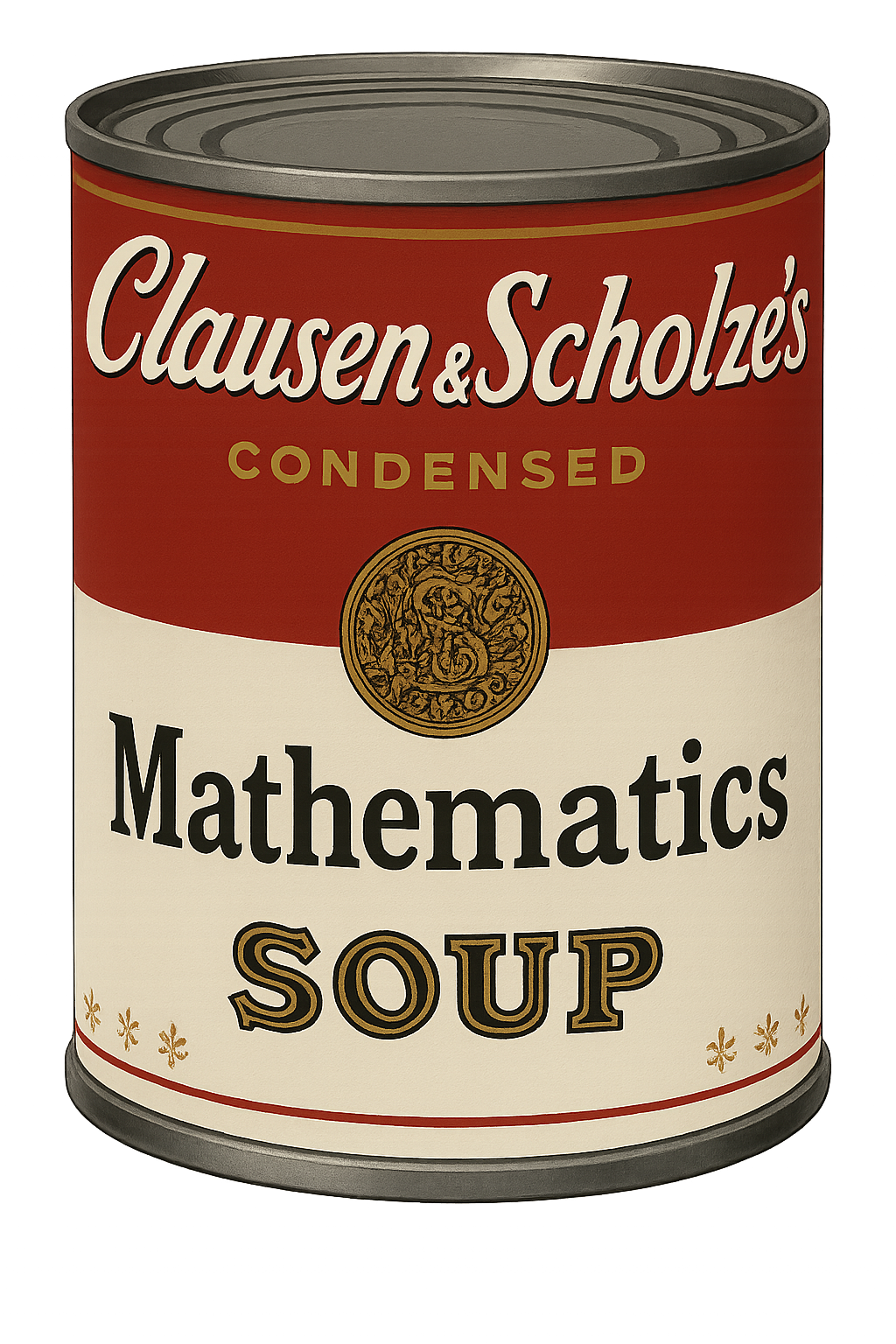
The picture above was generated with ChatGPT.
Reading group to learn about condensed mathematics following Kedlaya's online notes [Ked24] and author's 2024 graduate course at UC San Diego.
The aim of this talk is to provide a general overview of basic categorical language, motivated by concrete examples. Participants with a solid background in category theory may find much of the material familiar.
The outline of the talk is as follows:
In adittion to Le Stum's notes, the talk is based on Chapters 1—4 of Categories in context, by Emily Riehl and Chapters I—VIII of Algebra: Chapter 0, by Paolo Aluffi.
The aim of this talk is to provide a general overview of some categorical aspects, motivated by classical constructions and concrete examples. The emphasis is on compact Hausdorff spaces and on the use of categorical language to clarify and unify familiar topological notions.
The main reference for the talk is Le Stum's notes, in particular Chapter 1 (Sections 1.4.3 and 1.5.4) and Chapter 2 (Sections 2.1 and 2.2).
The outline of the talk is as follows:
These topics provide a natural entry point to the categorical framework underlying the theory of condensed sets.
In this talk we are going to introduce the definition of free compact Hausdorff space, Stone space and Stonean space, together with some key properties of these spaces and the categories they belong to.
Furthermore, throughout the talk we'll show some examples. Finally, our main goal is to provide characterizations of Stone spaces and Stonean spaces, as well as to introduce the Stone representation theorem.
We will follow section 2.2 of Le Stum's notes.
In this talk we will study the concept of closed cartesian category, along with associated concepts as the one of internal hom.
In particular, in the category of topological spaces, we consider the compact-open topology on spaces of maps. In order to have a cartesian closed category, we have to restrict to a subcategory, namely, the one of compactly generated Hausdorff spaces, consisting of those spaces that are colimits of compact Hausdorff spaces.
We will follow section 2.3 of Le Stum's notes.
This talk gives a brief introduction to condensed sets and some of their basic properties.
We discuss how topological spaces naturally embed into the category of condensed sets, present examples that do not arise from topological spaces, and provide some intuition for the richer nature of this framework.
In this talk we make essentially two constructions: we extend condensed sets to act on compact Hausdorff spaces by means of profinite resolutions and asign a topological space to every condensed set.
Those constructions are instances of the notion of Kan extension, which we also introduce. Moreover, we study properties of some of the functors involved.
In these two talks we will introduce the definition of topology on a category and study the associated theory of sheaves.
We discuss the notion of covering sieves on an object and the various interpretations of the concept, both in general, and in concrete examples relevant to our study.
We explain the sheafification process of a presheaf and give an overview of the properties underlying a category of sheaves. Furthermore, we give some insight on how condensed sets can be interpreted as sheaves on a given site, and explain the relation between previously studied properties of condensed sets and those arising from sheaves.
The first talk follows sections 3.1 and 3.2 of Le Stum's notes.
The second one follows sections 3.2 and 3.3 of Le Stum's notes.
In this talk we study solid modules over a discrete commutative ring following [Ked24, Section 1].
Solid modules over a commutative ring (in particular, solid abelian groups) are a generalization of the 'usual' discrete modules. In this category of solid modules, morphisms between finitely and infinitely generated free modules modules behave, in a certain sense, in the same way.
The first goal is to establish the basic definitions necessary to define solid modules and their operations.
We continue reading [Ked24, Section 1].
We give detailed proofs of some facts about solid modules, making clear how do we work with them.
Some highlights are: extension of scalars from discrete to solids is fully faithful but restriction isn't, and $\operatorname{Mod}_{R_\square}$ is a closed symmetric monoidal category where duality exchanges direct products and direct sums.
We will discuss the category of solid abelian groups, that is, solid modules over the integers, following Section 2 of [Ked24]. After a brief recap of previous weeks, we will compare the categories of solid and (topological) abelian groups, and the so-called Whitehead's problem in both contexts. We will then study in more detail finitely presented solid abelian groups.
|
[Ans24]
|
J. Anschütz, Lectures notes on topoi and condensed math, Link, 2024. |
|
[CS19a]
| D. Clausen and P. Scholze, Lectures on analytic geometry, Link, 2019. |
|
[CS19b]
|
, Lectures on condensed mathematics, Link, 2019. |
|
[CS20]
|
, Masterclass in condensed mathematics, Link, 2020. |
|
[Ked24]
|
K. S. Kedlaya, Notes on condensed mathematics, Link, 2024. |
|
[LS24]
|
B. Le Stum, An introduction to condensed mathematics, Link, 2024. |
|
[Z21]
|
T. Zhou et al., Condensed mathematics seminar, Link, 2021. |